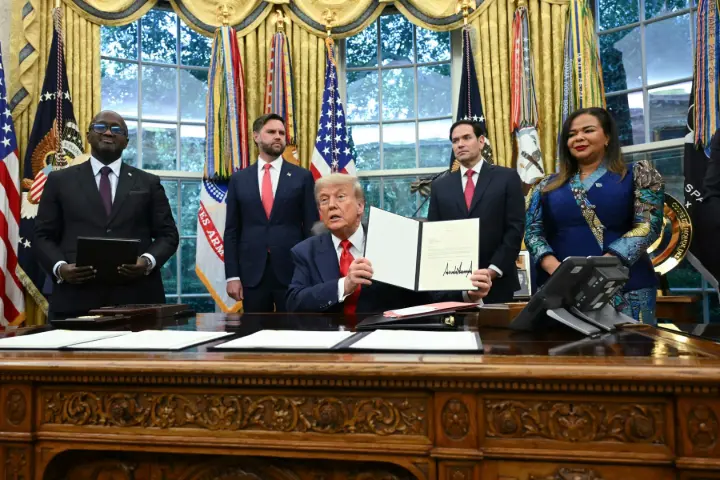
The Democratic Republic of Congo (DRC) and Rwanda recently signed a peace agreement hailed as a potential turning point for one of Africa’s longest-running conflicts. After years of mistrust, cross-border accusations, and devastating violence in eastern Congo, the deal, brokered with the involvement of the African Union (AU), the United States, and regional mediators,was meant to chart a new path toward stability.
But just weeks after its signing, the situation on the ground tells a different story. Armed groups like the M23 rebels and the ISIS-linked Allied Democratic Forces (ADF) continue to terrorize communities, displace families, and control key areas (Eurasia Review). Civilians, once hopeful, are watching with growing anxiety as promises on paper fail to translate into peace on the ground.
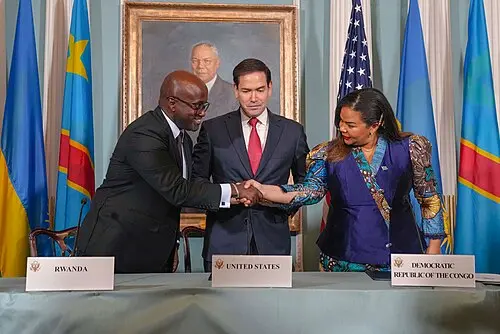
Why the Agreement is Struggling
At the heart of the challenge lies the issue of territorial control. The DRC insists on the withdrawal of foreign-backed armed groups, while Rwanda maintains security concerns linked to hostile militias operating from Congolese soil. Without a trusted enforcement mechanism, both sides remain reluctant to fully commit, fearing that any concession could be exploited by the other.
Moreover, deep mistrust between Kinshasa and Kigali complicates every step. Years of mutual blame, Rwanda accused of backing M23 (Reuters), and Congo accused of harbouring anti-Rwandan militias, have eroded confidence. As a result, even the most carefully crafted agreements risk collapse without credible oversight.
The Role of External Powers
The U.S. and AU played critical roles in brokering the deal, but their ability to enforce compliance is limited. Washington has provided diplomatic pressure and financial support for peacebuilding, yet its influence is increasingly challenged by competing players such as China and Russia (Modern Diplomacy). Meanwhile, the AU’s peace and security mechanisms face resource and capacity constraints, making it hard to monitor or deter violations on the ground.
Neighbouring states, especially Uganda and Burundi, also shape the conflict’s trajectory. Their involvement, whether in cross-border security operations or in covert support to armed groups, can either bolster the peace process or undermine it entirely. Regional cooperation is therefore not optional but essential.
What Needs to Change
For the peace agreement to hold, three critical steps are needed:
- Independent Monitoring – A robust, neutral body empowered to verify compliance and report transparently on violations.
- Regional Security Guarantees – A clear framework that binds all neighbours to non-interference and coordinated border security.
- Community Engagement – Local voices must be included in the peace process, ensuring that civilians see tangible benefits such as security, justice, and economic opportunity.
Without these measures, the peace agreement risks becoming yet another short-lived truce in a region weary of broken promises.
The DRC–Rwanda deal is more than a bilateral accord, it is a test of Africa’s ability to manage its own security crises in partnership with global powers. Success would mark a new chapter for Central Africa; failure could plunge the region back into a cycle of violence with consequences far beyond its borders.