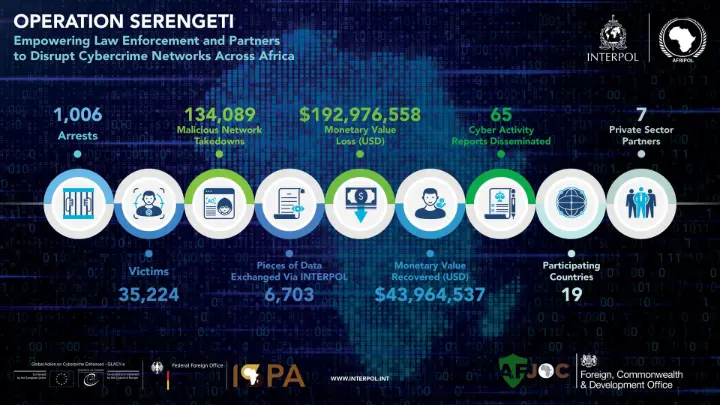
Interpol’s Serengeti 2.0 operation has unveiled the depth of Africa’s cybercrime challenge, leading to 1,209 arrests across 18 countries and the recovery of nearly $97.4 million, according to AP News. Conducted between June and August 2025, the operation targeted scams ranging from cryptocurrency fraud to inheritance cons that spanned borders and continents.
In Angola, authorities dismantled 25 illegal crypto-mining centres operated by Chinese nationals. Equipment worth $37 million was seized and later redirected to bolster the country’s power distribution networks. In Zambia, police broke up a massive online crypto fraud that swindled 65,000 victims out of nearly $300 million, recovering critical digital evidence in the process. Meanwhile, in Ivory Coast, investigators uncovered a transnational inheritance scam that had already siphoned off $1.6 million from unsuspecting victims abroad (Interpol report).

A Cross-Border Crime, A Cross-Border Response
Cybercrime is inherently transnational, with perpetrators, victims, and financial systems often spread across multiple jurisdictions. Interpol, with its 196 member countries, provided the intelligence-sharing framework that made Serengeti 2.0 possible. For many African states, where cybercrime units remain underfunded and laws outdated, the operation offered both training and technical support.
Still, challenges persist. Criminals are adopting increasingly sophisticated methods, from exploiting cryptocurrencies to using artificial intelligence to scale online scams. As a result, African law enforcement faces what one cyber policy expert described as a “moving target” that demands constant innovation (Modern Diplomacy).
Policy Implications for Africa
Experts warn that operations like Serengeti 2.0, while vital, are not a cure-all. African governments must invest in long-term cyber resilience, harmonize legislation, and deepen collaboration through frameworks such as the African Union’s Convention on Cyber Security and Personal Data Protection (African Union).
The rapid rise of mobile money and digital banking has boosted financial inclusion across Africa, but it has also created fertile ground for fraudsters. Without stronger regional coordination, the continent risks being seen as a global hotspot for digital crime.
Looking Ahead
Serengeti 2.0 is both a law enforcement milestone and a wake-up call. It shows that international partnerships can deliver tangible wins, but also that Africa’s cybercrime battle will not be won through arrests alone. Long-term solutions will depend on stronger laws, better public awareness, and greater investment in digital resilience.
As Interpol noted, only through sustained global cooperation can African states protect their citizens, economies, and reputations from the growing threat of cyber predators (Interpol).