As the war in Ukraine grinds into its fourth year, Kyiv is looking far beyond Europe for allies and Africa has become an increasingly important stage for this diplomatic chess game. New embassies are opening, trade missions are expanding, and Ukrainian officials are keen to present their country as a partner for security, investment, and food security.
But the question remains: can Ukraine truly compete in a continent where Russia has built decades of influence through military ties, resource deals, and political alliances?
Why Africa matters now
Africa is not just a collection of states for Ukraine; it represents a bloc of 54 votes at the United Nations. In a world where diplomatic numbers often translate into legitimacy, African support could tilt narratives on the global stage. For Kyiv, convincing African leaders to distance themselves from Russia’s orbit could weaken Moscow’s claim of global backing.
Beyond politics, there’s the practical question of trade. Ukraine has long been a supplier of grain to African countries. When Russia blocked Black Sea routes, African nations felt the shock of rising food prices. By positioning itself as a reliable agricultural partner, Ukraine is appealing directly to one of Africa’s most pressing concerns: food security.
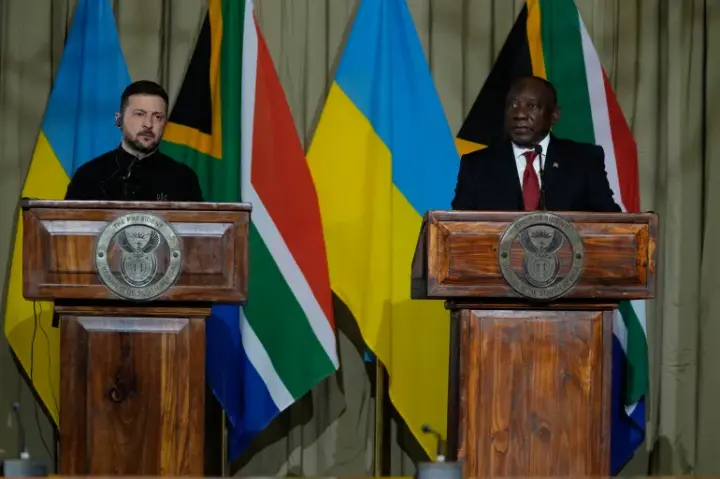
South African President Cyril Ramaphosa, right, and Ukrainian President Volodymyr Zelenskyy in Pretoria, South Africa. Photo by Themba Hadebe/AP
What’s in it for Africa?
African states, however, are not passive players in this story. Many are asking: what do we gain from Kyiv’s overtures?
For some, the answer lies in investment and development. Ukraine has signaled interest in technology and energy partnerships, areas where African countries are hungry for innovation. Others see potential in diversifying alliances: by engaging Ukraine, African leaders can balance their relationships with Russia, China, the U.S., and the EU, maximizing bargaining power.
There’s also a soft power angle. Ukraine frames its struggle as one of sovereignty and resistance against aggression a narrative that resonates with nations that endured colonialism. For some African leaders, supporting Kyiv offers a chance to connect with that shared history of struggle.
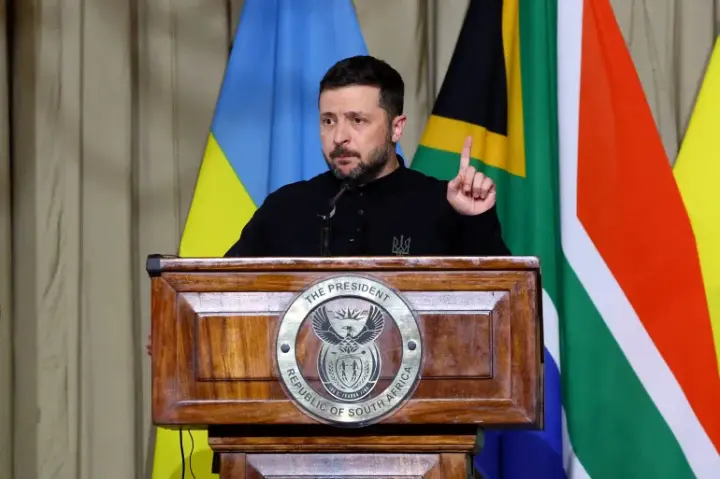
President Zelenskyy while in South Africa. Photo by Siphiwe Sibeko/Reuters
Africa as a Diplomatic “Swing Region”
The real contest is less about military alliances and more about perception. Africa is emerging as a swing region in global diplomacy not fully aligned with the West, not entirely with Russia, but charting an independent path.
Ukraine’s challenge is clear: to prove that its promises translate into tangible benefits. Russia, meanwhile, is doubling down on security partnerships and resource deals to maintain its foothold.
For African states, this competition could bring leverage and if played wisely, it could mean better deals, stronger partnerships, and more say in shaping the international order.
The continent, once sidelined in global power politics, is now in the spotlight. And both Kyiv and Moscow know it.
Sources: