On 17 September 2025, the South African government once again placed itself at the centre of global diplomacy by calling for urgent international action on Gaza. This followed the release of a UN Human Rights Council inquiry which concluded that Israel has committed acts amounting to genocide in the territory.
For Pretoria, the findings are not just another UN report. They reaffirm the case South Africa has been building before the International Court of Justice (ICJ) since December 2023, when it first accused Israel of violating the Genocide Convention. Since then, South Africa has filed multiple dossiers of evidence, addressed the court in The Hague, and pushed the issue in diplomatic circles.
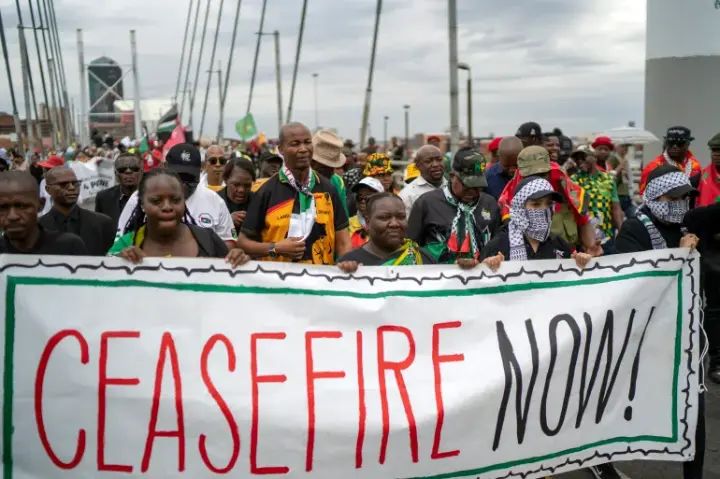
Pro-Palestinian demonstrators march across the Mandela Bridge downtown Johannesburg, South Africa in 2023. Photo by Jerome Delay/AP Photo
Using international law as diplomacy
South Africa’s approach demonstrates how middle powers can use international law and multilateral institutions as instruments of diplomacy. By taking Israel to the ICJ, South Africa has elevated its voice far beyond the African continent. It has framed its stance not merely as political solidarity with Palestinians but as a principled defence of international law.
This positions South Africa as a champion of rules-based order an identity it has been eager to project since the end of apartheid. Yet it also tests the credibility of those institutions: what happens when ICJ provisional orders, such as those instructing Israel to prevent genocidal acts, are ignored?
The limits of enforcement
Here lies the dilemma. The ICJ has no police force. Its rulings carry weight in international law but rely on states to respect and enforce them. Many Western governments, including the United States and European Union members, have so far offered political cover to Israel despite the ICJ’s findings.
South Africa’s statement therefore raises difficult questions: Can international justice function when powerful states selectively comply? And what does it mean for smaller states that look to the ICJ for protection against aggression or mass atrocities?
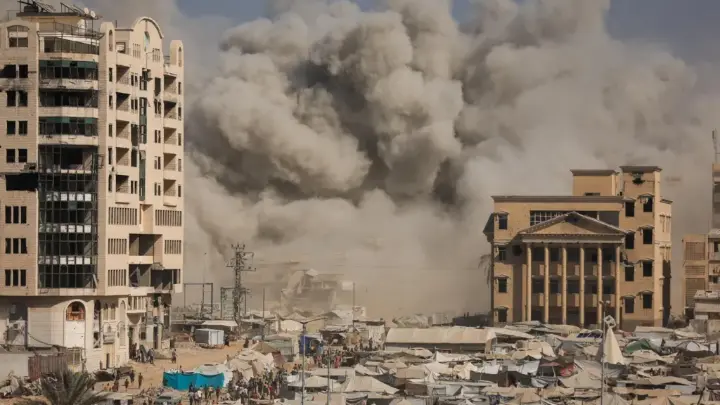
An Israeli air strike destroyed another high-rise building in Gaza City on Monday
Foreign policy implications
This assertive stance could reshape South Africa’s diplomatic relations. Ties with Israel are already strained, while Pretoria risks friction with Washington and European capitals. At the same time, its leadership resonates strongly in the Global South, where calls for reforming international institutions and addressing double standards are growing louder.
By challenging major powers on such a sensitive issue, South Africa signals that it is willing to accept diplomatic costs to uphold its moral and legal arguments. Whether that strengthens its credibility or isolates it remains to be seen.
What is clear is that on 17 September 2025, South Africa reminded the world that international law is only as strong as the willingness of states to uphold it.
Sources: