In recent years, Africa has become a stage for shifting global power plays, but 2025 marks a clear intensification of one player’s strategy: Russia. With military delegations visiting Mali, Niger, and Burkina Faso, a growing presence of the so-called “Africa Corps,” and fresh cooperation agreements with Togo and Cameroon, Moscow is steadily embedding itself in the continent’s security landscape.
Unlike the West’s often conditional partnerships, Russia’s approach emphasizes rapid support, military training, and intelligence cooperation. For governments facing insurgencies or political instability, this no-strings-attached style is attractive. But beneath the surface, it raises pressing questions: what does Russia’s deeper involvement mean for Africa’s security, sovereignty, and international positioning?
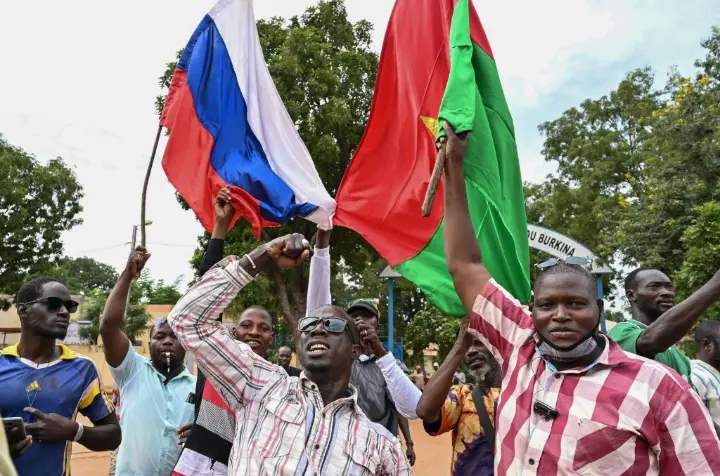
Supporters of Burkina Faso’s new junta leader Capt. Ibrahim Traoré hold Russian and Burkinabe flags during a demonstration in Ouagadougou in 2022. AFP/GETTY IMAGES
For decades, France held sway in West Africa, deploying troops, advising governments, and maintaining close economic ties. But discontent with French influence, seen in mass protests in Mali, Burkina Faso, and Niger, created fertile ground for Russia to step in. Similarly, the U.S. maintains military bases and counter-terrorism operations, while China invests heavily in infrastructure and resource extraction. Russia’s strategy does not aim to match these players economically; instead, it leverages security cooperation to gain a foothold where others are losing trust.
This creates a new form of competition: while France and the U.S. are seen by some as overbearing, Russia positions itself as a partner that listens, equips, and protects. Whether this perception holds true in the long run remains to be seen.
Public opinion across African states is far from uniform. In some countries, Russian involvement is celebrated as a form of liberation from Western dominance. Images of citizens waving Russian flags at rallies in Bamako or Ouagadougou underline this symbolic embrace. Yet in other regions, skepticism is growing. Civil society groups question whether Russia is truly offering solidarity or simply replacing one form of dependency with another.
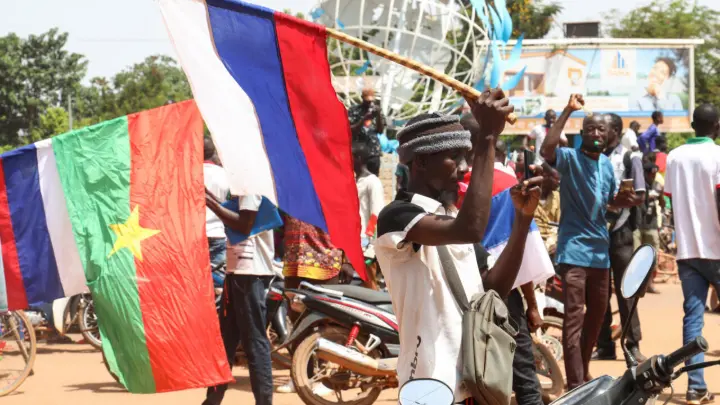
Supporters of Burkina Faso's new junta wave Burkina Faso and Russian flags at a protest in Ouagadougou in 2022. Photo by Vincent Bado, Reuters
For leaders, the calculation is pragmatic. Military support provides short-term stability, but the long-term risks of over-reliance on Moscow remain unclear.
The stakes are high. Russia’s expanding military diplomacy in Africa could tilt regional balances of power, reshape alliances, and redefine how external actors engage with the continent. For African nations, the challenge lies in leveraging this interest to strengthen sovereignty, not erode it. For the wider world, it’s a reminder that Africa is not just a passive recipient of global influence, it is an active arena where new forms of diplomacy are being tested.
As 2025 unfolds, one thing is certain: Russia’s role in Africa is no longer peripheral. It is central to the continent’s evolving security narrative and to the future of global power competition.
Sources: