When President Cyril Ramaphosa touched down in Jakarta, Indonesia on 22 October 2025, it marked more than a routine state visit it was a statement of intent. The visit, part of a three-nation tour across Southeast Asia, highlights South Africa’s growing diplomatic confidence and its mission to expand relations beyond traditional Western partners.
According to South Africa’s Department of International Relations and Cooperation (DIRCO), Ramaphosa’s discussions with Indonesian President Prabowo Subianto focused on boosting trade, investment, and multilateral cooperation. Both leaders reaffirmed their commitment to work closely within global platforms like the BRICS, the G20, and broader South-South cooperation frameworks.
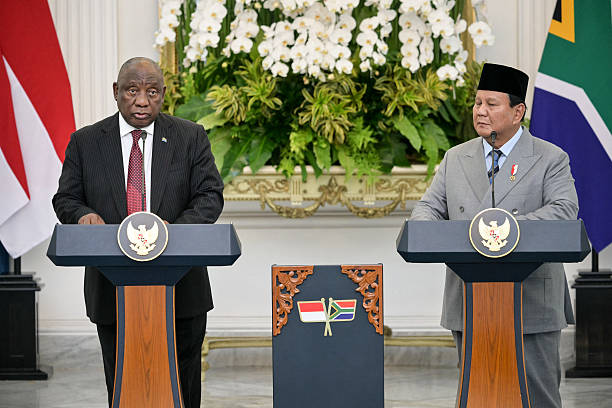
South Africa's President Cyril Ramaphosa (L) and Indonesia's President Prabowo Subianto attend a press conference after their bilateral meeting at the presidential palace in Jakarta on October 22, 2025. (Photo by BAY ISMOYO/AFP via Getty Images)
This visit is especially symbolic as South Africa prepares to assume the G20 presidency in 2025 a moment that could redefine Africa’s global voice. By engaging with Indonesia, a fellow member of the G20 and BRICS-aligned economy, South Africa is signaling that Africa’s diplomacy is no longer one-dimensional. It’s strategic, diversified, and forward-looking.
For decades, Africa’s trade and diplomacy have been shaped largely by North-South relations often tilted in favour of donor-recipient dynamics. This new phase, however, is different. It’s about equal partnerships, knowledge exchange, and mutual growth.
Indonesia and South Africa share similar ambitions: to strengthen domestic industries, build regional resilience, and amplify the collective voice of the Global South. Their meeting reflects a broader trend emerging economies collaborating to balance global power and create fairer, more inclusive trade systems.
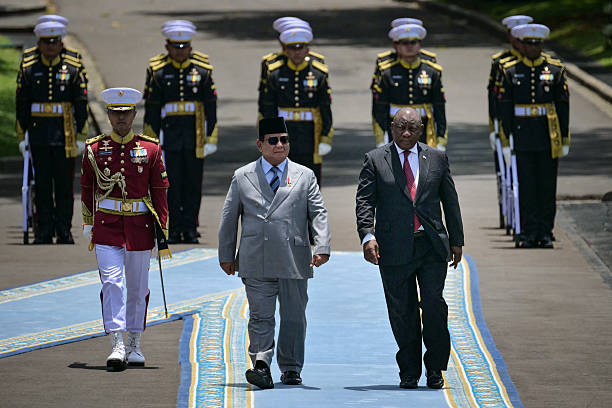
This engagement also sends a message to the rest of Africa: the future lies in cross-regional partnerships. Whether through technology exchange, renewable energy, or maritime trade, nations like South Africa and Indonesia are showing that diplomacy can be a tool for innovation, not just protocol.
As global alliances evolve, Africa’s leading economies are learning to play multiple diplomatic cards, engaging East and West, North and South, while keeping the continent’s interests at heart.
In essence, Ramaphosa’s Jakarta visit isn’t just about trade deals. It’s about Africa claiming its space in global diplomacy confidently, collaboratively, and creatively.