“Trade or Trust?” That’s the big question Kenya faces as it pushes for a stronger economic partnership with the United States.
President William Ruto has announced that Kenya expects to finalize a bilateral trade agreement with Washington by the end of 2025. At the same time, Nairobi is lobbying for a five-year extension of the African Growth and Opportunity Act (AGOA) — a U.S. law that has, for years, given African exports duty-free access to American markets.
On the surface, this looks like a win. But the stakes are high, and the risks are real.
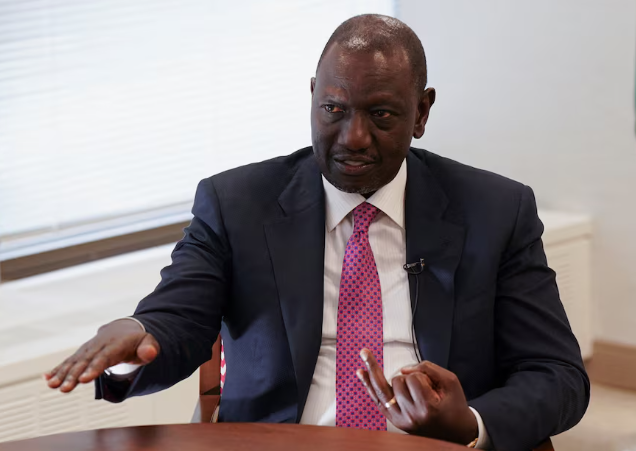
William Ruto, President of Kenya at the Permanent Mission of the Republic of Kenya to the United Nations, during the 80th United Nations General Assembly (UNGA) in New York, U.S., September 24, 2025. Photo by Bing Guan/REUTERS.
AGOA has been a lifeline for many African economies. In Kenya, it has supported industries such as textiles, flowers, and agricultural exports. If extended, it could mean thousands of jobs protected and billions in trade revenue.
But there’s a catch. The U.S. recently slapped a 10% tariff on Kenyan exports under the Trump administration’s trade agenda (Reuters). This move raised eyebrows in Nairobi, with many wondering: Can Kenya really trust Washington to uphold fair trade terms?
Kenya is at a crossroads. While deepening ties with the U.S. could bring investment and market access, it also raises tough questions about sovereignty and dependency.
- Will Kenya gain a fair deal, or will tariffs keep undermining its exports?
- Can Nairobi balance ties with Washington while also strengthening its growing partnerships with China, the EU, and regional blocs?
- And perhaps most importantly: does betting big on AGOA leave Africa vulnerable if the U.S. changes course again?
This is where diplomacy meets reality. For Kenya, it’s not just about trade figures — it’s about trust, leverage, and long-term strategy.
Across Africa, countries are watching closely. Lesotho has already hinted at a possible one-year AGOA extension (Reuters), but uncertainty looms large. If Washington fails to renew AGOA for the long term, the ripple effects could be devastating for smaller economies.
At the same time, leaders like Ruto are under pressure to diversify trade partners, so Africa isn’t left hostage to shifting U.S. policies.
Kenya’s push for a U.S. trade deal and AGOA renewal is bold, but it’s also risky. The coming months will test whether Washington sees Africa as a genuine partner — or just a pawn in global trade politics.
For now, one thing is clear: Kenya must play smart, balancing ambition with caution. Because in diplomacy, as in trade, trust is often worth more than tariffs.