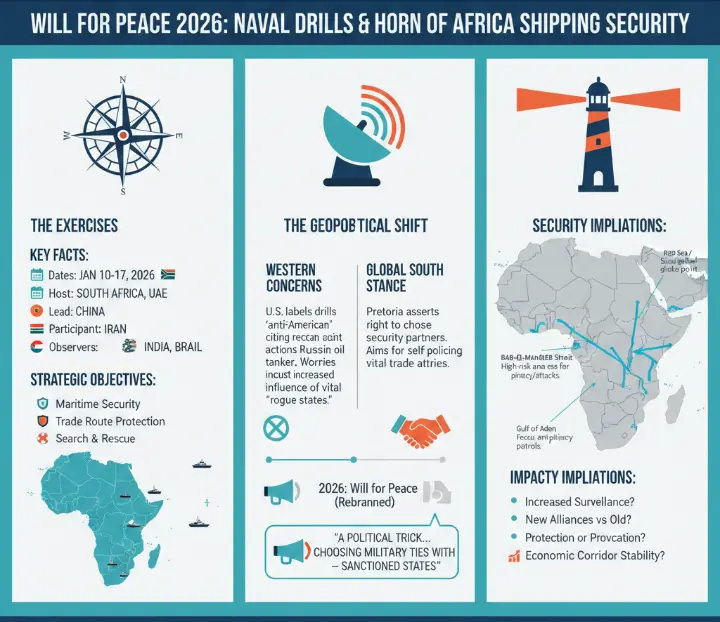
The waters off the coast of South Africa are currently churning with more than just the Atlantic tide. From January 10–17, 2026, the South African Navy is hosting the "Will for Peace 2026" naval exercises; a high-stakes, rebranded successor to the controversial Exercise Mosi.
While the name suggests tranquility, the guest list and the timing have sent shockwaves from Washington to the Horn of Africa.
The Lineup: A "Who’s Who" of Global Shifts
Led by China, the drills feature a coalition that has the West checking its radar:
- Russia: Deploying the Steregushchiy-class corvette Stoykiy.
- Iran: Marking an expanded military footprint in African waters with the IRIS Makran.
- UAE: Participating as a newer BRICS+ member.
- The Observers: Notably, founding BRICS members India and Brazil have chosen to remain on the sidelines, sending observers rather than warships, a move seen as a tactical "middle ground" to avoid further straining ties with the West.
Why It Matters: Security vs. Sovereignty
Pretoria has remained firm, labeling these exercises "essential" for maritime security. The official goal? Protecting vital trade routes and enhancing counter-terrorism and search-and-rescue interoperability.
However, with the Horn of Africa already a focal point for global maritime security due to shifting alliances and shipping threats, these drills represent more than just practice. They are a signal that the "Global South" is looking to police its own backyard.
The timing couldn't be more sensitive. The U.S. has slammed the exercises as "anti-American," particularly because they come on the heels of a recent U.S. naval operation against a Russian oil tanker.
At a Glance: "Will for Peace 2026"
| Feature | Details |
| Dates | January 10–17, 2026 |
| Lead Nation | China |
| Location | Simon’s Town & Cape Town, South Africa |
| Key Assets | Guided-missile destroyers, refueling tankers, and anti-submarine helicopters |
| The Friction | Occurring amid U.S. sanctions on Russia and Iran |
The Verdict: A Message in a Bottle?
Is "Will for Peace" truly about safeguarding shipping lanes, or is it a "coming out party" for a new era of naval coordination that excludes the West? As China and Russia solidify their influence from the Cape of Good Hope to the Red Sea, the maritime balance of power is clearly shifting.